
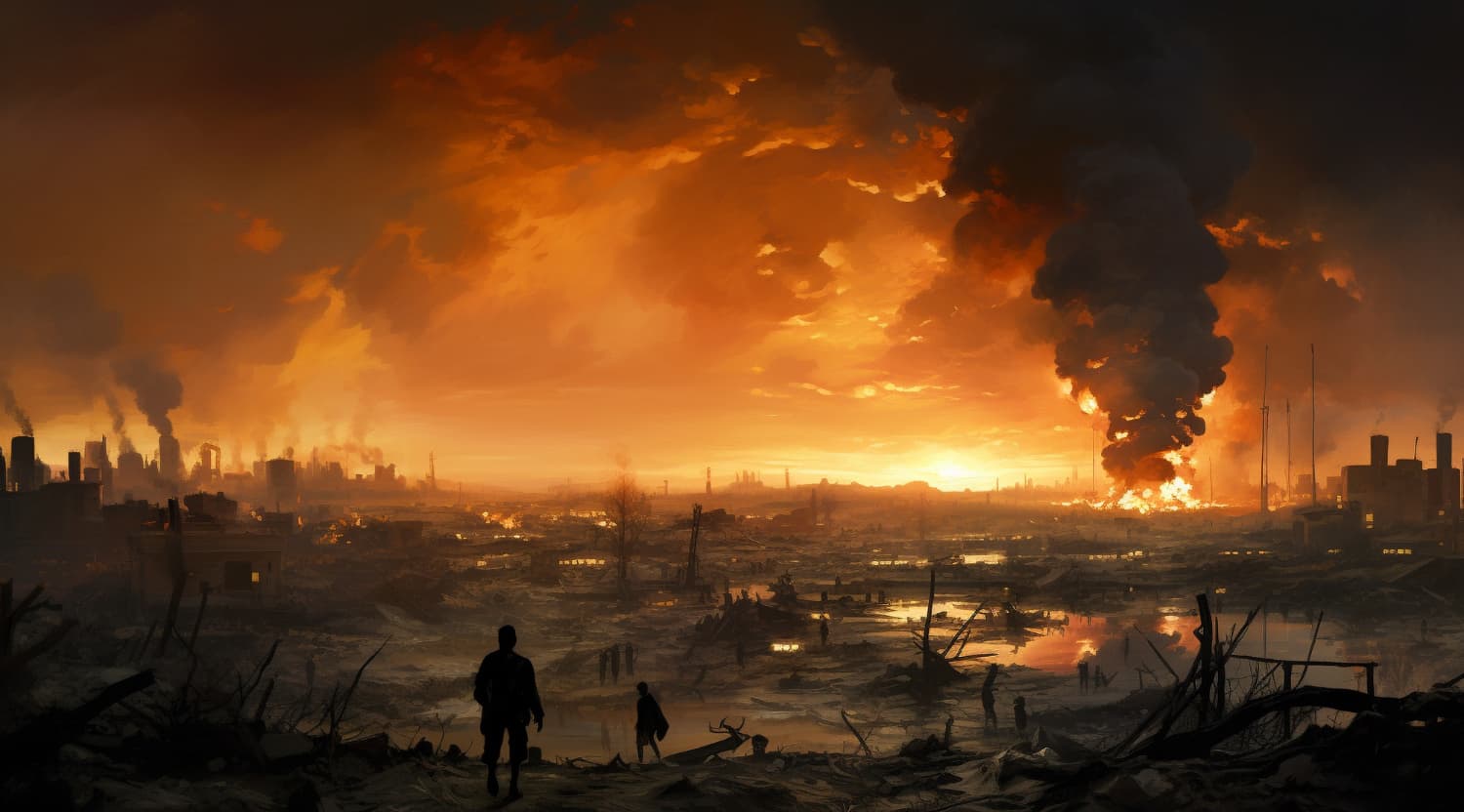
The Cold War stands as one of the most defining geopolitical rivalries in modern history; a decades-long ideological, political, and military standoff between two superpowers that shaped the fate of nations across every continent. Though no direct large-scale military conflict occurred between the two primary adversaries, the Cold War left a profound imprint on international relations, technology, culture, and the everyday lives of billions of people around the world.
What Is the Cold War? (Meaning & Definition)
The term “Cold War” refers to the state of sustained political hostility, ideological competition, and indirect military confrontation between the United States (and its Western allies) and the Soviet Union (and its Eastern Bloc satellite states) that lasted roughly from 1947 to 1991. Unlike conventional wars, the Cold War involved no direct, declared combat between the two superpowers. Instead, the conflict was waged through proxy wars, propaganda, espionage, economic competition, and an unprecedented arms race.
The word “cold” is used precisely because the war never officially “heated up” into open warfare between the US and USSR; yet the tension it generated was anything but cool. The ideological divide was stark: the United States championed liberal democracy and free-market capitalism, while the Soviet Union promoted Marxist-Leninist communism and a centrally planned economy.
The phrase itself is widely attributed to the British author and journalist George Orwell, who used it in a 1945 essay, You and the Atomic Bomb, to describe a world living under the shadow of nuclear threat. American financier and presidential advisor Bernard Baruch later popularized the term in a 1947 speech, and journalist Walter Lippmann brought it into mainstream political discourse through his influential writings.
Historical Background: Seeds of the Cold War
The Pre-War Tensions (1917–1939)
The roots of the Cold War stretch back to the Russian Revolution of 1917, when the Bolsheviks, led by Vladimir Lenin, overthrew the Tsarist regime and established the world’s first communist state. Western powers, including the United States and Britain, were deeply alarmed by this new ideology, which explicitly called for the overthrow of capitalist systems worldwide. The US did not formally recognize the Soviet Union until 1933, reflecting this deep mutual suspicion.
During the interwar period, ideological tensions simmered. The Western democracies and the Soviet Union held fundamentally incompatible visions for the post-war world order. Any wartime alliance between them was, at best, a marriage of necessity.
World War II and the Uneasy Alliance (1939–1945)
The Nazi invasion of the Soviet Union in June 1941 (Operation Barbarossa) thrust the USSR into alignment with the Allied powers; Britain and, after December 1941, the United States. The Grand Alliance united three very different political systems against a common fascist enemy. Despite cooperation, deep distrust never fully abated. The Soviets believed the Western powers delayed the opening of a second front in Western Europe (D-Day did not occur until June 1944) to let the USSR bear the brunt of Nazi military power; a grievance that colored relations for decades.
The Yalta Conference of February 1945, attended by Franklin D. Roosevelt, Winston Churchill, and Joseph Stalin, was a pivotal moment. The “Big Three” agreed on the post-war reorganization of Europe, including the division of Germany and free elections in Eastern Europe. In practice, however, Stalin’s interpretation of “free elections” and “spheres of influence” diverged dramatically from the Western understanding; a fault line that would crack the alliance wide open once Germany was defeated.
The Beginning of the Cold War (1945–1947)
The Post-War Power Vacuum
The end of World War II in 1945 left a dramatically altered global landscape. The traditional European great powers; Britain, France, Germany; were either exhausted or devastated. Two nations emerged as superpowers: the United States, economically dominant and in sole possession of the atomic bomb, and the Soviet Union, with the world’s largest standing army and control over vast territories across Eastern Europe and Central Asia.
As Soviet forces had liberated much of Eastern Europe from Nazi occupation, Stalin moved quickly to install pro-Soviet communist governments in Poland, Romania, Bulgaria, Hungary, Czechoslovakia, and East Germany. Winston Churchill famously described this development in his 1946 “Iron Curtain” speech in Fulton, Missouri:
“An iron curtain has descended across the Continent.”
This speech crystallized Western anxieties about Soviet expansionism and is widely regarded as one of the rhetorical opening salvos of the Cold War.
The Truman Doctrine and Containment (1947)
In 1947, communist insurgencies threatened the governments of Greece and Turkey. President Harry S. Truman addressed a joint session of Congress in March 1947, articulating what became known as the Truman Doctrine; a commitment to support free peoples resisting subjugation by armed minorities or outside pressures. This represented a fundamental shift in American foreign policy toward active global engagement against communist expansion.
Simultaneously, diplomat and historian George F. Kennan authored the seminal “Long Telegram” (1946) and the influential “X Article” (1947), in which he advocated a strategy of “containment”; blocking Soviet expansion at every point it threatened to spread, rather than attempting to roll back communism where it already existed. Containment became the cornerstone of US Cold War strategy for the next four decades.
The Marshall Plan (1948)
Recognizing that economic desperation was fertile ground for communist ideology, the United States launched the European Recovery Program; better known as the Marshall Plan; in 1948. Named after Secretary of State George C. Marshall, the program provided approximately $13 billion (equivalent to roughly $150 billion today) in economic aid to rebuild war-devastated Western European economies. The Soviet Union rejected the plan and pressured its Eastern European satellites to do the same, further deepening the East-West divide.
The Cold War Intensifies (1947–1962)
The Berlin Blockade (1948–1949)
Berlin, located deep within Soviet-occupied East Germany but divided among the four Allied powers, became an early Cold War flashpoint. In June 1948, Stalin ordered a blockade of West Berlin, cutting off all land routes to the city in an attempt to force the Western powers to abandon it. The Western response was the remarkable Berlin Airlift; a massive logistical operation that flew supplies into the city around the clock for nearly a year. By May 1949, the Soviets lifted the blockade, a significant early Western victory in the Cold War.
NATO and the Warsaw Pact
In 1949, the United States and its Western allies formalized their military alliance by creating the North Atlantic Treaty Organization (NATO), committing member states to collective defense under the principle that an attack on one was an attack on all. The Soviet Union responded in 1955 with the Warsaw Pact, a military alliance of Eastern Bloc nations. Europe was now divided not merely politically and economically, but militarily.
The Soviet Atomic Bomb and the Nuclear Arms Race
When the Soviet Union successfully tested its first atomic bomb in August 1949, it shattered the American monopoly on nuclear weapons and dramatically escalated Cold War tensions. The two superpowers now entered a frenzied nuclear arms race. The US developed the hydrogen bomb in 1952; the Soviets followed in 1953. By the 1960s, both nations possessed enough nuclear warheads to destroy civilization many times over; a strategic condition known as Mutually Assured Destruction (MAD), which paradoxically served as a deterrent against direct conflict.
The Korean War (1950–1953)
The Cold War turned hot on the Korean Peninsula in June 1950, when North Korean forces (backed by the Soviet Union and China) invaded South Korea. The United States, under a United Nations mandate, led a military coalition to defend the South. After three years of brutal fighting and an eventual stalemate near the original border, an armistice was signed in 1953. Korea demonstrated that Cold War competition could and would draw the superpowers into devastating proxy conflicts.
The Space Race
Cold War rivalry extended beyond Earth. The Soviet launch of Sputnik; the world’s first artificial satellite; on October 4, 1957, sent shockwaves through the United States and inaugurated the Space Race. The Soviets followed with the first human in space, Yuri Gagarin, in April 1961. The United States responded with the Apollo program, ultimately landing Neil Armstrong on the Moon on July 20, 1969. The Space Race was as much a propaganda contest as a scientific endeavor; proof that one system of government could out-innovate the other.
The Cuban Missile Crisis (1962)
The most dangerous moment of the Cold War; indeed, of modern history; came in October 1962, when American reconnaissance aircraft discovered Soviet nuclear missiles being installed in Cuba, just 90 miles from the Florida coast. For 13 tense days, the world stood at the brink of nuclear war. President John F. Kennedy demanded the missiles’ removal and imposed a naval blockade of Cuba. After intense back-channel negotiations, Soviet Premier Nikita Khrushchev agreed to withdraw the missiles in exchange for a US pledge not to invade Cuba and the quiet removal of American Jupiter missiles from Turkey. The crisis demonstrated how close the Cold War could come to global catastrophe.
The Cold War’s Middle Years (1962–1979)
Détente
Following the near-catastrophe of the Cuban Missile Crisis, both superpowers recognized the need to manage their rivalry more carefully. The period from the late 1960s through the 1970s saw a phase of détente; a relaxation of Cold War tensions through diplomacy and negotiation. Key milestones included:
- The Nuclear Test Ban Treaty (1963), prohibiting atmospheric nuclear tests.
- The Strategic Arms Limitation Talks (SALT I, 1972), which placed ceilings on nuclear weapons arsenals.
- President Nixon’s landmark visit to China in 1972, which exploited the Sino-Soviet split to realign global power dynamics.
- The Helsinki Accords (1975), which recognized post-war European borders and included human rights provisions.
The Vietnam War
The Cold War’s logic of containment drew the United States into the catastrophic Vietnam War. American involvement escalated through the late 1950s and 1960s, with massive troop deployments beginning in 1965 under President Lyndon B. Johnson. The war was devastating: over 58,000 American soldiers and an estimated 2–3 million Vietnamese died. The fall of Saigon in April 1975 marked a major communist victory and a deeply traumatic chapter in American Cold War history.
The Final Phase and the End of the Cold War (1979–1991)
The Soviet Invasion of Afghanistan (1979)
Détente effectively ended when the Soviet Union invaded Afghanistan in December 1979 to shore up a failing communist government. The US, under President Jimmy Carter, responded by boycotting the 1980 Moscow Olympics and arming Afghan mujahideen fighters through a CIA operation. The Soviets became mired in a devastating nine-year conflict that many analysts compare to America’s experience in Vietnam; draining resources, morale, and international credibility.
The Reagan Doctrine and the Second Cold War
President Ronald Reagan (1981–1989) pursued an aggressively anti-Soviet foreign policy, dramatically increasing defense spending, deploying new nuclear missiles in Europe, and launching the Strategic Defense Initiative (SDI); a proposed missile defense system critics nicknamed “Star Wars.” Reagan’s rhetoric was unambiguous: he famously called the Soviet Union an “evil empire” in 1983.
Mikhail Gorbachev and the Soviet Collapse
The decisive turning point came from within the Soviet Union itself. When Mikhail Gorbachev became General Secretary of the Communist Party in 1985, he introduced two transformative policies: glasnost (openness; a relaxation of censorship and greater political transparency) and perestroika (restructuring; limited market reforms). These policies, intended to revitalize a stagnating Soviet system, instead unleashed forces that would ultimately destroy it.
By 1989, communist regimes across Eastern Europe were collapsing with stunning speed. The Berlin Wall; the most potent physical symbol of the Cold War; fell on November 9, 1989, as jubilant crowds tore it apart. Germany was reunified in October 1990. On December 25, 1991, Gorbachev resigned and the Soviet flag was lowered over the Kremlin for the last time. The Union of Soviet Socialist Republics (USSR) formally dissolved, and the Cold War was over.
Legacy of the Cold War
The Cold War’s legacy is immense and continues to shape our world:
- Nuclear proliferation: The arms race produced enormous nuclear arsenals that still exist. Arms control remains a central challenge of international security.
- Global alliances: NATO continues to operate, expanding eastward after 1991; a source of ongoing tension with Russia.
- Proxy conflicts: Wars in Korea, Vietnam, Afghanistan, Angola, Nicaragua, and dozens of other nations were shaped by Cold War rivalries, leaving long-lasting devastation.
- The spread of democracy: The Cold War’s end was accompanied by a significant global wave of democratization in the 1990s.
- Technological innovation: The Space Race and military competition accelerated the development of computers, the internet, satellite communications, and numerous technologies that define modern life.
- Cultural impact: Cold War anxieties permeated literature, film, art, and popular culture; from nuclear-age science fiction to the spy thriller as a literary genre.
Conclusion
The Cold War was far more than a political or military rivalry between two nations. It was a global struggle over the very organization of human society; a contest between competing visions of freedom, governance, and the good life. Its four-plus decades shaped decolonization, accelerated technological development, generated devastating proxy conflicts, and kept humanity under the constant shadow of nuclear annihilation. Understanding the Cold War is essential to understanding the world we inhabit today; from the structure of global alliances to the persistence of regional conflicts rooted in that era’s logic. Its history offers both cautionary lessons about the dangers of ideological rigidity and reminders of how profoundly diplomatic creativity and human courage can pull the world back from the brink.