
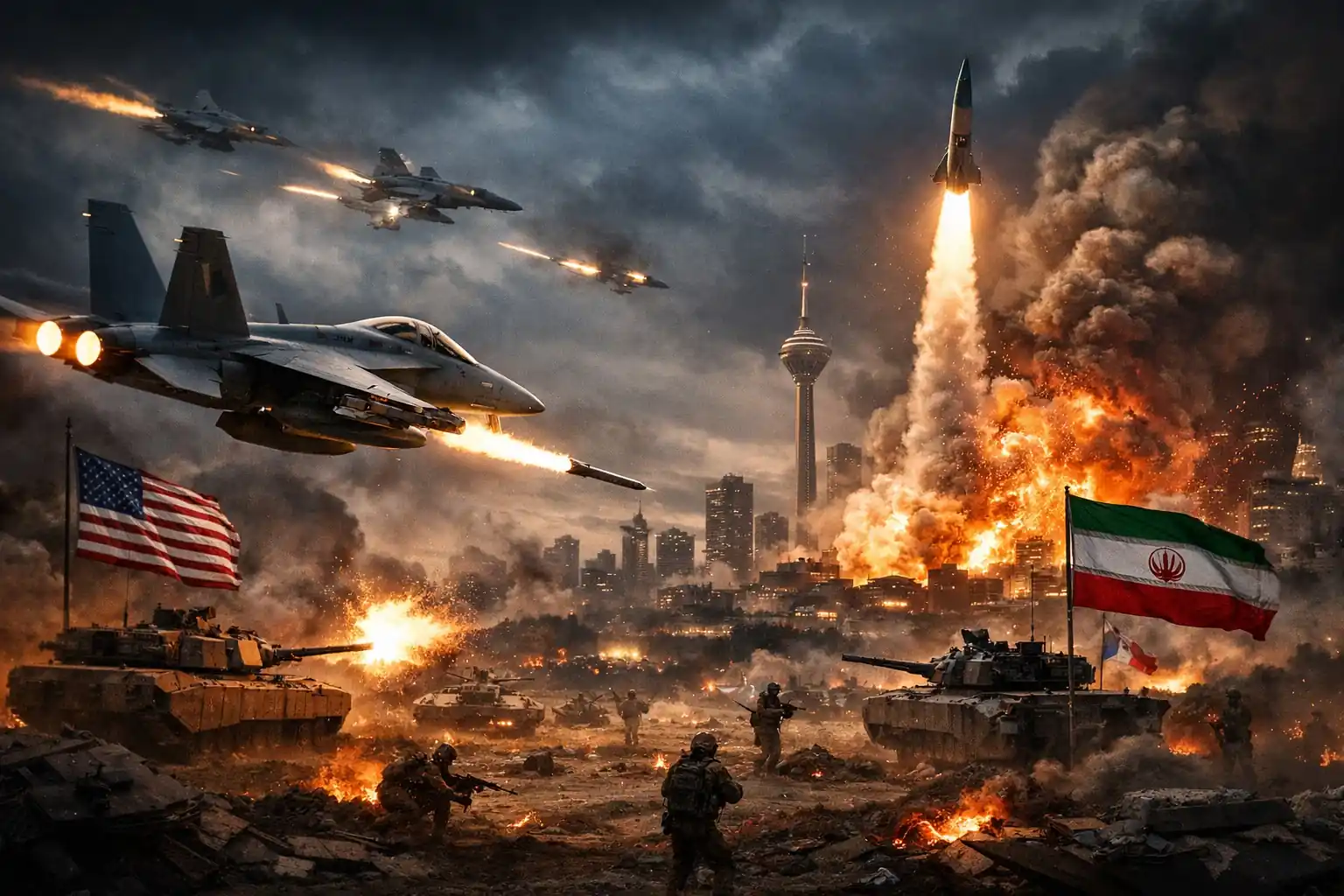
Introduction: A New Era of Confrontation
The world in 2026 feels eerily reminiscent of the Cold War era — not with the Soviet Union, but with a different adversary: Iran. What began as decades of simmering hostility has now erupted into open military conflict, proxy warfare, and a terrifying nuclear standoff. The United States and Iran are locked in a confrontation that analysts are increasingly calling “Cold War 2.0” — a dangerous blend of ideology, geopolitics, and weapons of mass destruction that threatens not just the Middle East, but global stability.
Decades of Distrust: How We Got Here
The roots of the America–Iran conflict stretch back to 1979, when the Islamic Revolution overthrew the U.S.-backed Shah and Ayatollah Khomeini declared America the “Great Satan.” The Iran hostage crisis cemented decades of mutual hatred and deep mistrust. Tensions between the United States and Iran stretch back to the Islamic Revolution in 1979, with the immediate concerns leading up to the 2026 conflict including Iran’s nuclear program, its ballistic missiles, its military reach in the Middle East, and failed attempts to renegotiate a nuclear deal after the collapse of the 2015 Joint Comprehensive Plan of Action (JCPOA).
For years, the world tried diplomacy. The JCPOA in 2015 was meant to cap Iran’s nuclear ambitions in exchange for sanctions relief. But it collapsed, and every subsequent attempt at negotiation fell apart under the weight of mutual suspicion and hardline politics on both sides.
The Nuclear Question: How Close Was Iran?
At the heart of Cold War 2.0 lies the question that has haunted Washington and Tel Aviv for decades: Was Iran building a nuclear bomb?
In December 2024, the UN nuclear watchdog IAEA reported enrichment to levels approaching weapons-grade and found an unprecedented stockpile of highly enriched uranium without a credible civilian purpose, giving Iran the capacity to produce enough fissile material for multiple bombs on short notice.
The program also received external assistance, including from Pakistan and North Korea, with the latter supplying both missiles and uranium.
Yet experts were divided on the immediacy of the threat. Arms control experts disputed Trump’s claim that Iran “soon” could have missiles capable of reaching the U.S., and they said there was a lack of evidence that the country had “attempted to rebuild” nuclear enrichment facilities damaged by earlier U.S. strikes. The debate over real versus perceived threat would become one of the most consequential intelligence disputes of the modern era.
Operation Epic Fury: America Strikes
On February 28, 2026, the world changed. U.S. and Israeli forces launched nearly 900 strikes in 12 hours targeting Iranian missiles, air defenses, military infrastructure, and leadership. The initial wave of strikes killed Supreme Leader Ali Khamenei and dozens of other officials.
President Trump authorized “Operation Epic Fury” — described as a precise, overwhelming military campaign to eliminate the imminent nuclear threat posed by the Iranian regime, destroy its ballistic missile arsenal, degrade its proxy terror networks, and cripple its naval forces.
In a televised address, Trump accused Iran of reviving efforts to build nuclear weapons and advanced missile capabilities that could threaten the U.S., Europe, and U.S. bases overseas. He framed the strikes as a necessary act of preemption.
But not everyone agreed. Joe Kent resigned as Director of the National Counterterrorism Center on March 17, 2026, saying he “cannot in good conscience support the ongoing war in Iran,” adding that Iran “posed no imminent threat to our nation” and that the war was started “due to pressure from Israel and its powerful American” backers.
Iran Strikes Back: The Region Ignites
Iran’s retaliation was swift and wide-ranging. Iran launched hundreds of drones and ballistic missiles at targets in Israel and at U.S. military bases in Bahrain, Jordan, Kuwait, Qatar, and Saudi Arabia. The conflict quickly sucked in neighboring nations. Iran also said it would shut the Strait of Hormuz, a major oil and trading route. Shipping was affected and regional oil and gas production was cut.
The human cost was devastating. The attacks left more than 2,000 people dead in Iran, Lebanon, and Israel, with hundreds of thousands displaced in Lebanon and hundreds of thousands of travelers stranded across the Middle East.
The Nuclear Fallout: Mission Accomplished?
Despite the scale of the strikes, nuclear experts warned that the threat had not been eliminated. Although strikes can set back Iran’s nuclear program and destroy key infrastructure, military force cannot eliminate Tehran’s proliferation risk. At the end of the conflict, Iran will retain the nuclear expertise and likely key materials necessary for building a nuclear bomb.
Furthermore, the ongoing military action — and Trump’s threats to deploy U.S. troops to seize Iran’s enriched uranium — is creating a new set of nuclear risks and safety hazards. The possibility of a nuclear reactor being accidentally struck, or Iran targeting Israel’s own Dimona nuclear complex in retaliation, has raised the specter of radiological catastrophe.
The Cold War 2.0 Framework
Why call this Cold War 2.0? Because like the original Cold War, this is not simply a military conflict — it is a clash of civilizations, ideologies, and spheres of influence. America represents Western liberal democracy and Israeli security. Iran represents theocratic nationalism, anti-Western resistance, and the aspirations of millions across the Muslim world who see U.S. intervention as imperialism.
Many of Iran’s regional allies had been significantly weakened, primarily by Israeli military action from 2023 onward. Iran’s counter-strikes on Arab Gulf states, who had sought to deepen relations with Iran in recent years, may also leave it further isolated. The old Middle Eastern order is being redrawn — just as Europe was reshaped in the original Cold War.
Conclusion: The World on the Brink
Cold War 2.0 between America and Iran is a conflict that blends the existential dread of nuclear weapons with the complexity of modern proxy warfare, economic sanctions, and information battles. The strikes of February 28, 2026 may have disrupted Iran’s nuclear timeline — but they have not ended the confrontation. They may have deepened it.
The central question now is not whether Iran can build a bomb — it is whether the world can find a path back to diplomacy before the next escalation crosses a threshold no one can walk back from. As in the original Cold War, the danger is not just in the weapons themselves — it is in the fear, miscalculation, and pride of nations convinced they have no choice but to push further.
Want to know about Cold War? Read Our Article on Cold war!