
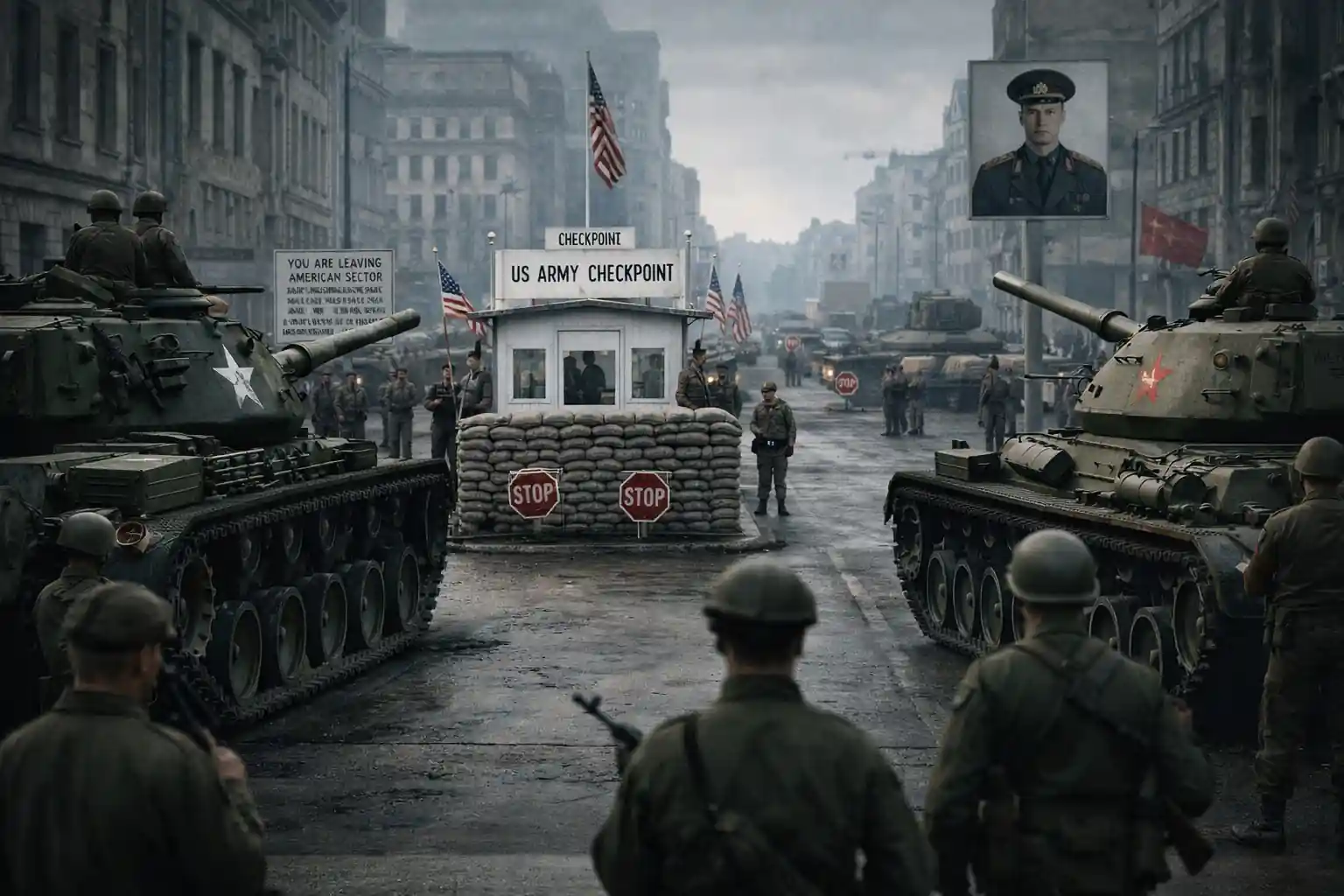
There are wars fought on battlefields, and then there are wars fought in shadows. The Cold War was both — simultaneously one of the most consequential geopolitical confrontations in modern history and one of the most invisible. Fought not primarily with tanks and artillery but with ideologies, intelligence operatives, nuclear warheads, and carefully managed fear, the Cold War defined the architecture of the world we inhabit today. To study it is to understand not just the past, but the logic that continues to drive great power behaviour in the 21st century.
This is the story of two superpowers, the secrets they kept from each other — and from their own people — and the nuclear shadow that hung over every decision for nearly five decades.
The Two Superpowers: Who Were They and What Did They Want?
When World War II ended in 1945, the old European imperial order lay in ruins. In its place stood two powers of an entirely new scale and character — the United States and the Soviet Union. They had fought as allies against Nazi Germany and Imperial Japan, but the alliance was one of necessity, not affinity. The moment the common enemy was defeated, the ideological gulf between them yawned open.
The United States: Champion of Liberal Capitalism
The United States emerged from World War II as the dominant economic and military power on earth. Its industrial base was intact, its treasury enriched by wartime production, and it held — for a brief but consequential few years — a monopoly on nuclear weapons. Washington’s vision for the post-war world was shaped by liberal democratic values, free-market economics, and a firm belief that open societies and open markets would produce prosperity and stability.
American foreign policy was also, however, shaped by strategic interest. The US wanted access to global markets, friendly governments in strategically significant regions, and above all, the prevention of any single power from dominating the Eurasian landmass — the largest concentration of resources, population, and industrial capacity on earth.
The Soviet Union: The Communist Superpower
The Soviet Union had endured the most catastrophic losses of any combatant in World War II — an estimated 27 million citizens killed, vast stretches of its western territory utterly devastated. Stalin’s primary post-war objective was security: a buffer of friendly — or, more precisely, obedient — states in Eastern Europe to prevent any future invasion from the west.
Ideologically, the USSR was committed to Marxist-Leninism, a system of governance that concentrated economic and political power in the state and the Communist Party, and which explicitly regarded capitalism as an exploitative system destined for historical obsolescence. Moscow believed, with ideological conviction, that history was on its side — that the contradictions of capitalism would eventually produce revolutionary change across the world.
These were not merely different foreign policies. They were opposing worldviews about the fundamental nature of political and economic life.
The Nuclear Dimension: How the Bomb Changed Everything
No feature of the Cold War was more consequential — or more psychologically defining — than nuclear weapons. The United States detonated the world’s first atomic bomb in the New Mexico desert on July 16, 1945. Less than a month later, it dropped atomic bombs on the Japanese cities of Hiroshima and Nagasaki, instantly killing over 100,000 people and accelerating Japan’s surrender.
The message to the Soviet Union was unmistakable. Washington possessed a weapon of almost incomprehensible destructive power — and Moscow did not.
How the Soviets Got the Bomb — And Why It Happened Faster Than Anyone Expected
American intelligence estimated the Soviet Union would not acquire nuclear capability until the mid-1950s at the earliest. They were catastrophically wrong. The Soviet Union detonated its first nuclear weapon in 1949, closely modelled on the US’s “Fat Man” bomb dropped on Nagasaki — far sooner than anticipated. Stratfor The reason for this stunning acceleration was not Soviet scientific genius alone. It was espionage.
During World War II, Moscow had prioritised the infiltration of the Manhattan Project, America’s nuclear weapons research programme. Soviet agents were able to obtain and pass on technical information about this programme, including blueprints, with remarkable ease. The Geopolitics The most prominent figures in this nuclear spy network were Julius and Ethel Rosenberg, American citizens who were convicted of passing nuclear secrets to the Soviet Union. They were executed in 1953 — the only American civilians put to death for espionage during the Cold War.
Clandestine atomic spies from the Soviet Union, who infiltrated the Manhattan Project during WWII, played a major role in increasing the tensions that led to the Cold War. Foreign Policy When Stalin had been informed of the Manhattan Project at Potsdam in July 1945 — supposedly a revelation — he showed no surprise. He already knew.
Mutually Assured Destruction: The Logic of Nuclear Terror
By the early 1950s, both superpowers had nuclear weapons. By the late 1950s, both had hydrogen bombs — thermonuclear devices vastly more powerful than the atomic bombs dropped on Japan. By the 1960s, both had intercontinental ballistic missiles (ICBMs) capable of delivering nuclear warheads to any point on earth within minutes.
This produced one of the most grimly rational strategic doctrines in human history: Mutually Assured Destruction, or MAD. The logic was stark. If either superpower launched a nuclear first strike, the other retained sufficient weapons to annihilate the aggressor in retaliation. Since both sides knew this, neither side would rationally initiate nuclear war. The terror was mutual — and therefore, paradoxically, stabilising.
The Cuban Missile Crisis of 1962 tested this logic to its absolute limit. When the United States discovered Soviet nuclear missile installations being constructed in Cuba, President Kennedy imposed a naval blockade and demanded their removal. For thirteen days in October, the world stood at the edge of nuclear war. A single miscalculation — a trigger-happy naval commander, a misread signal, a technical malfunction — could have ended modern civilisation. The crisis was ultimately resolved through back-channel diplomacy, but it accelerated both superpowers’ interest in arms control agreements and direct communication channels.
The famous Moscow–Washington hotline, the so-called “red telephone,” was established in 1963 specifically to prevent a future crisis from escalating beyond human control due to a failure of communication.
The World of Secrets: Intelligence, Espionage & Covert Operations
If nuclear deterrence was the Cold War’s spine, then espionage was its nervous system — the vast, hidden infrastructure through which each superpower attempted to understand the other’s intentions, capabilities, and vulnerabilities.
The CIA vs. The KGB: The Great Intelligence Rivalry
The central intelligence organisation overseeing top-secret information gathering in the United States was the CIA (Central Intelligence Agency), while in the Soviet Union this role was performed by the KGB, formed in 1954. Geopolitical Monitor These two agencies became the defining symbols of Cold War covert competition.
The KGB — Komitet Gosudarstvennoy Bezopasnosti, or Committee for State Security — was responsible for both foreign intelligence collection and domestic security, making it a uniquely powerful and pervasive instrument of state control. It was the successor to a long lineage of Soviet secret police organisations stretching back to Lenin’s Cheka, and it brought to the Cold War decades of sophisticated tradecraft.
At the start of the Cold War, in the 1930s and ’40s, Soviet spies had been able to penetrate the top levels of the US government. Stratfor The CIA, by contrast, struggled throughout much of the Cold War with significant counterintelligence failures. The close US–UK intelligence relationship also created a vulnerability: Soviet spies embedded in British intelligence were able to betray the secrets of both countries simultaneously. Stratfor
The Cambridge Five: Betrayal from the Elite
Perhaps the most consequential spy network of the Cold War era was not composed of opportunistic defectors or ideologically confused government clerks — it was an elite coterie of British establishment figures who had been recruited while students at Cambridge University during the 1930s.
The Cambridge Five included Kim Philby, Donald Maclean, Guy Burgess, Anthony Blunt, and John Cairncross — a group responsible for passing sensitive information to the Soviet Union, including details about British intelligence operations and NATO’s military strategy. The Diplomat
Kim Philby’s case was particularly devastating. He rose to become head of the Soviet counter-intelligence section at MI6 — meaning the man tasked with catching Soviet spies was himself the most senior Soviet spy in British intelligence. He had been passing information to Moscow since the mid-1930s, and defected to the USSR in 1963. The Geopolitics The Cambridge Five compromised an enormous number of Western intelligence operations and are believed to have contributed to the deaths of multiple agents.
Covert Operations: When Intelligence Became Intervention
Both the CIA and KGB were not merely passive collectors of intelligence. They actively intervened in the political affairs of foreign countries — destabilising governments, funding political movements, organising coups, and running disinformation campaigns on a global scale.
The CIA’s interventions included the 1953 coup in Iran (Operation Ajax), which overthrew the democratically elected Prime Minister Mohammad Mosaddegh and restored the Shah; the 1954 coup in Guatemala that removed President Jacobo Árbenz; and the catastrophic Bay of Pigs operation in 1961, an attempted CIA-organised invasion of Cuba that collapsed in embarrassment.
One of the CIA’s most controversial programmes was Project MK-ULTRA, which ran from 1953 to the late 1960s and involved research into hypnosis and mind-altering drugs with a view to Cold War applications. Hundreds of Americans — mostly military personnel — were subjected to drug trials and experimentation without their informed consent. The Geopolitics MK-ULTRA represents perhaps the most disturbing instance of a democratic government using its own citizens as experimental subjects in the name of national security.
The KGB, for its part, perfected what it called “active measures” — a comprehensive toolkit of disinformation, forgeries, media manipulation, and support for militant groups designed to advance Soviet foreign policy goals and undermine Western cohesion.
Proxy Wars: The Cold War Fought Through Other People
Because direct military confrontation between the superpowers carried the risk of nuclear escalation, the Cold War’s hot violence was largely outsourced to other countries. Both the US and USSR armed, trained, funded, and advised local factions in regional conflicts — turning the civil wars and independence struggles of the developing world into arenas for superpower competition.
Korea: The First Hot War of the Cold War
When North Korea invaded South Korea in June 1950 — with Soviet backing and Chinese support — the United States intervened under a UN mandate. The Korean War lasted three years, cost over 36,000 American lives and millions of Korean civilian casualties, and ended in a stalemate that persists to this day. The peninsula remains divided at roughly the same line along which the war began, with North Korea now a nuclear-armed state — one of the Cold War’s most enduring and dangerous legacies.
Vietnam: The War That Broke the American Consensus
If Korea was the Cold War’s first major hot conflict, Vietnam was its most traumatic for the United States. American involvement escalated through the 1960s under the strategic logic of the “domino theory” — the belief that if one country fell to communism, neighbouring nations would follow in sequence. By 1969, over 500,000 US troops were deployed in South Vietnam.
The war was ultimately unwinnable through the methods Washington chose to employ. North Vietnamese forces, supported by the Soviet Union and China, absorbed enormous punishment and continued fighting. American public opinion fractured catastrophically. The war ended in 1975 with the fall of Saigon — a searing humiliation that reshaped US foreign policy and domestic politics for decades.
Afghanistan: The Soviet Union’s Vietnam
In December 1979, the Soviet Union invaded Afghanistan to prop up a failing communist government in Kabul. It would prove to be a fatal strategic miscalculation. The United States, through the CIA’s Operation Cyclone, covertly armed and funded the Afghan Mujahideen resistance — the largest covert operation in CIA history. The Soviets found themselves trapped in a decade-long guerrilla war they could not win. The Afghan campaign drained Soviet military resources, devastated morale, and contributed significantly to the internal crisis that ultimately destroyed the USSR.
The Arms Race: Technology as National Ideology
Beyond nuclear weapons, the Cold War produced a relentless competition in conventional military technology, intelligence-gathering systems, and ultimately space exploration. Both superpowers understood that technological superiority was not merely a military asset — it was an ideological statement about which system of government could better organise human ingenuity.
The Space Race: Competition Beyond Earth
When the Soviet Union launched Sputnik, the world’s first artificial satellite, on October 4, 1957, the shock in Washington was profound. The same rocket technology that put Sputnik in orbit could deliver a nuclear warhead to any American city. The Soviets followed with Yuri Gagarin’s orbit of Earth in April 1961 — the first human in space.
The United States responded with an extraordinary national mobilisation. President Kennedy committed the US to landing a man on the moon before the end of the decade. On July 20, 1969, Apollo 11 achieved that goal. The moon landing was not merely a scientific achievement — it was a statement, broadcast live to hundreds of millions of people around the world, about American capability and determination.
Spy Satellites and Surveillance Technology
As both sides built up vast intelligence apparatuses, technology became increasingly central to information collection. The CIA’s U-2 spy plane flew reconnaissance missions over Soviet territory at altitudes designed to place it beyond the range of Soviet air defences — until 1960, when one was shot down over the USSR and its pilot, Gary Powers, was captured. The incident scuttled a planned US-Soviet summit and demonstrated that no intelligence operation was truly secure.
The subsequent development of satellite reconnaissance systems allowed both superpowers to monitor each other’s military installations from orbit — a development that, paradoxically, contributed to strategic stability, since each side could verify the other’s capabilities and was less vulnerable to surprise.
Détente and the Drift Toward Confrontation’s End
By the late 1960s and into the 1970s, both superpowers were experiencing pressures — economic, domestic, and geopolitical — that created an opening for reduced tension. The policy of Détente, associated with US President Richard Nixon and his National Security Advisor Henry Kissinger, sought to manage competition with the Soviet Union through negotiation, trade, and formal arms limitation agreements.
The Strategic Arms Limitation Talks (SALT I, 1972) and subsequent agreements placed formal caps on certain categories of nuclear weapons for the first time. Nixon’s dramatic visit to China in 1972 — opening relations with a country the US had refused to recognise for over two decades — fundamentally altered the strategic landscape, introducing a triangular dynamic into what had been a bilateral competition.
Détente, however, proved fragile. The Soviet invasion of Afghanistan in 1979, and the election of Ronald Reagan in 1980 on a platform of assertive anti-communism, ushered in a sharp renewal of Cold War tension. Reagan’s proposed Strategic Defence Initiative — the so-called “Star Wars” programme — alarmed Moscow by threatening to erode the mutual vulnerability that underpinned nuclear deterrence. Intelligence assessments have subsequently revealed that Soviet leadership in the early 1980s was genuinely, dangerously afraid of a US first strike — a miscalculation that brought the world closer to nuclear war than most people then realised.
The Final Chapter: How the Cold War Ended
By the mid-1980s, the structural problems of the Soviet system had become acute. The economy was stagnating. The war in Afghanistan was bleeding men and treasure. The technological gap with the West was widening. When Mikhail Gorbachev came to power in 1985, he attempted to save the Soviet system through the twin policies of Glasnost (political openness) and Perestroika (economic restructuring).
The reforms unleashed forces that could not be controlled. Nationalist movements surged across the Soviet republics. Eastern European satellite states — Poland, Hungary, Czechoslovakia, East Germany, Romania, Bulgaria — threw off communist rule in rapid succession through 1989. The Berlin Wall fell on November 9, 1989, an image that defined a generation.
On December 25, 1991, Mikhail Gorbachev resigned as President of the Soviet Union. The USSR was formally dissolved. The flag of the Soviet Union was lowered over the Kremlin for the last time. The Cold War was over.
Historians have since noted that the intelligence provided by both the KGB and CIA helped avert direct nuclear war — because both sides, through their spy networks, had enough understanding of the other’s capabilities and intentions not to be caught off-guard. Stratfor The greatest success of the intelligence war, it turned out, was not any particular coup or stolen document — it was the prevention of the catastrophe that both sides most feared.
What the Cold War Means for the World Today
The Cold War did not end cleanly. It left behind a world whose security architecture, alliance structures, and strategic assumptions were built for a specific kind of rivalry — and that architecture remains largely in place, even as the nature of the rivalry has evolved.
NATO, created as a Cold War instrument, has expanded to include 32 member states and remains the primary vehicle for Western collective security. Its eastward expansion since 1991 is at the heart of Russian grievances and the strategic logic underpinning the war in Ukraine.
Nuclear deterrence remains operative. Russia retains the world’s largest nuclear arsenal. China is rapidly expanding its own. India, Pakistan, North Korea, and Israel all possess nuclear weapons. The logic of MAD — the cold calculation that mutual destruction prevents first use — continues to govern the most consequential relationships in international security.
And the ideological dimension has returned with new protagonists. The US-China rivalry increasingly echoes the structural dynamics of the original Cold War — two systems, two ideologies, two visions for global order competing for influence across every continent, every technology sector, and every international institution. Whether this constitutes a “New Cold War” or something meaningfully different is among the most consequential debates in contemporary geopolitics.
Conclusion
The Cold War was simultaneously the most dangerous and the most carefully managed confrontation in human history. Two superpowers, each armed with enough nuclear weapons to destroy civilisation multiple times over, spent nearly half a century competing with extraordinary ferocity — and yet never pulled the trigger on each other. The role of secrets in sustaining that dangerous equilibrium was immense: intelligence gave each side windows into the other’s intentions and prevented the kind of catastrophic miscalculation that turns cold wars into hot ones.
What the Cold War ultimately demonstrated is that ideology is not merely rhetoric — it is a force capable of reshaping continents, toppling governments, and sustaining decades of sacrifice and fear. It also demonstrated that the most existential conflicts are often not resolved by force, but by the slow internal exhaustion of systems that cannot adapt. The Soviet Union did not lose a battle. It lost its coherence.
That lesson deserves careful reading in an era when great power competition is once again the defining feature of the international order.
GeopoliticsX provides independent analysis of global affairs, strategic competition, and international security. This article is part of our ongoing series on Cold War history and its relevance to contemporary geopolitics.